
METHOD / JOURNAL
Trading Journal Guide
A useful trading journal explains which decision was made, what was known at the time and what happened afterward. A screenshot of winning trades is not a record.
The minimum evidence record
| Field | Why it matters |
|---|---|
| Timestamp / timezone | Places the idea in the correct market context |
| Instrument and contract | Defines exactly what was hypothetically or actually traded |
| Thesis and source | Shows what motivated the decision |
| Entry assumptions / risk | Provides baseline quantities and planned invalidation |
| Lifecycle changes | Preserves cancellations, updates and expiries |
| Actual outcomes and costs | Separates real execution from assumptions |
| Verification status | Distinguishes backtests, paper and real fills |
A four-stage research process
- 1. Setup: state the instrument, time and falsifiable thesis.
- 2. Risk: define initial exposure using the Position Size Calculator and its contract assumptions.
- 3. Record: keep revisions, fills, fees and unresolved or cancelled events rather than deleting inconvenient outcomes.
- 4. Review: analyze distributions, risk multiples and drawdown instead of relying on an isolated win rate.
Separate real and simulated results
Backtested, simulated, demo and verified executed trades have different evidence quality and execution constraints. They must not be merged into a single advertised historical performance figure.
Privacy by default
The planned TradingSignals Decision Chain journal will prefer local processing and explicit user control of exports. This guide does not assert that the journal software is already publicly available, and the website does not collect your account statements on this page.
Frequently asked questions
Why record losing trades and expired setups?
Excluding negative or incomplete outcomes biases any statistical conclusion. The denominator must be defined before calculating a strategy metric.
Can a journal prove a strategy is profitable?
A journal provides evidence and traceability, not proof of future returns. Sample quality, costs, market regimes and independent verification still matter.
Continue with Expectancy, Performance Methodology and the complete toolkit.
Educational risk notice: Trading can lead to substantial or complete loss of capital. These illustrative methods are not personal investment advice, a recommendation to trade, a broker endorsement or evidence of real performance.
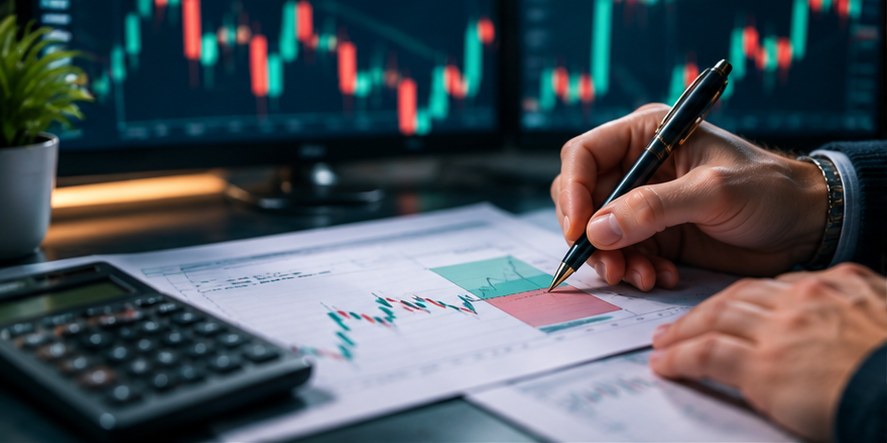
ILLUSTRATIVE RESEARCH GRAPHIC · NOT LIVE DATA
The research decision chain
Charts here explain a method. They do not use a licensed market feed, a live quote, realized investment returns or an audited performance history.