
Structured trading signal ideas delivered in real time via Telegram
Trading Psychology & Risk Awareness
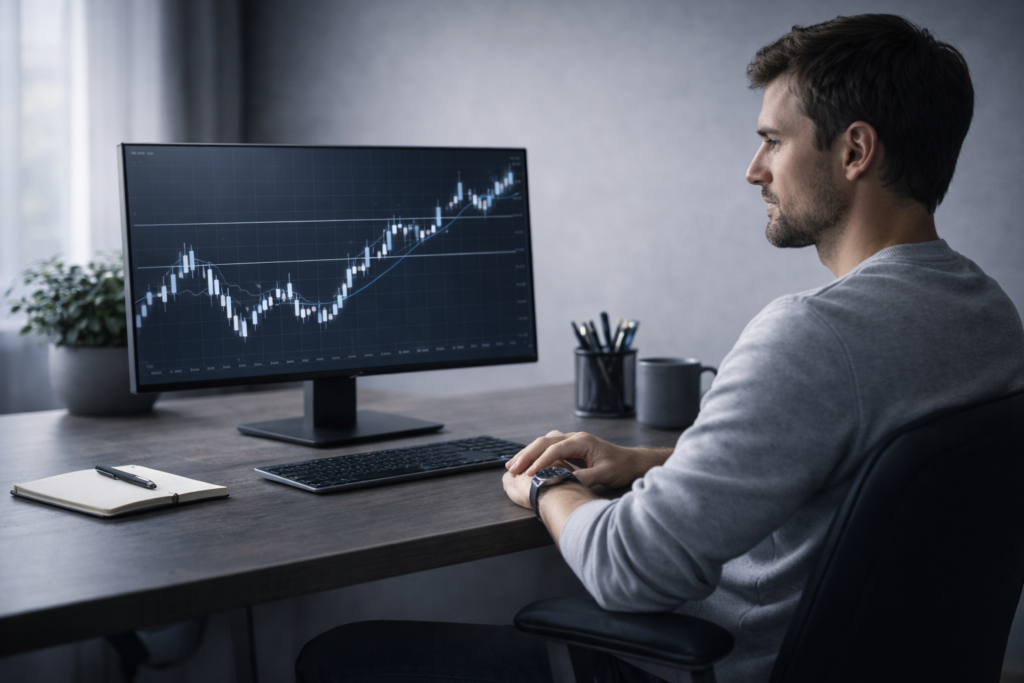
+ A calm trader observing charts without placing a trade
+ Why patience is a skill, not missed opportunity
+ Trading discipline in real market conditions
One of the hardest lessons in trading is learning when not to trade.
Many traders associate activity with progress. No trade feels like wasted time. Screens are open, markets are moving, and doing nothing feels uncomfortable. Yet in reality, some of the most disciplined decisions in trading are the ones where no position is taken.
This article explains why staying out of the market is sometimes the most rational choice, how overtrading develops, and why patience plays a central role in long-term consistency.
Not every market move is a trading opportunity
Markets move constantly, but meaningful opportunities do not appear constantly.
Price can drift, consolidate, or behave erratically without offering clear structure or acceptable risk. Entering trades during these phases often leads to small losses, emotional decisions, or unnecessary exposure.
Waiting is not indecision.
Waiting is selection.
Why overtrading happens so easily
Overtrading rarely starts with greed.
It often starts with discomfort.
Silence feels wrong. No signal feels like something is missing. Traders begin to lower their standards slightly. One extra setup here, one “almost good” trade there.
Over time, discipline erodes.
This is why fewer trades often lead to better results, not worse ones.
Why no trade is still a decision
Choosing not to trade is still an active decision.
It protects capital. | It preserves focus. | It avoids emotional noise.
Professional traders spend more time waiting than executing. They understand that patience is part of risk management, not a lack of confidence.
Trading is not about being active.
It is about being selective.
How trading signals fit into this mindset
Well-structured trading signals respect inactivity.
Signals should appear only when conditions align, not because a schedule demands it. Periods without signals are not a failure of the system. They are a sign of discipline.
This is why trading signals should be used as filters, not triggers.
Psychological pressure and the fear of missing out
Fear of missing out is one of the strongest emotional drivers in trading.
Seeing price move without you creates tension. But chasing movement often leads to late entries and poor risk profiles.
Markets will always offer new opportunities.
Capital lost to impatience is harder to recover.
Final thoughts
No trade is sometimes the most profitable trade.
It keeps discipline intact.
It protects mental capital.
It reinforces respect for structure and risk.
Trading is not about catching every move.
It is about surviving long enough to take the right ones.