
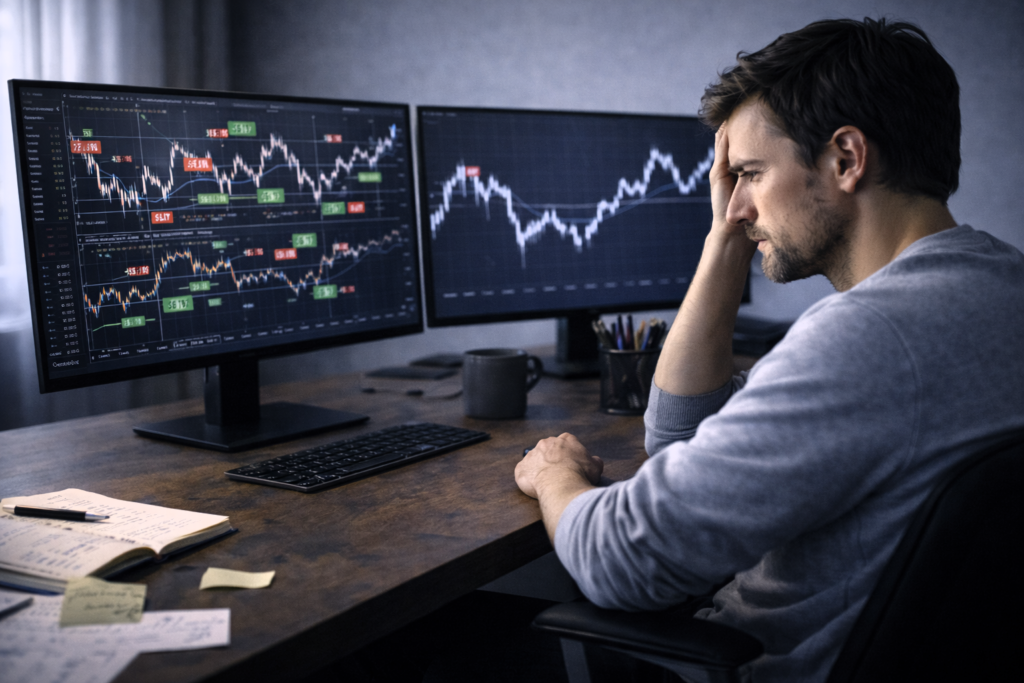
Why Traders Feel the Need to Trade Too Often
Psychological Pressure, Market Noise, and the Illusion of Opportunity
Overtrading is one of the most common reasons why retail traders struggle, even when their market analysis is not fundamentally wrong.
Many traders assume losses come from bad entries or poor signals. In reality, the issue is often how often trades are taken rather than which trades are taken.
This article explains why overtrading happens, how it quietly increases risk, and why structured decision-making often leads to better long-term results.
Why Overtrading Feels Logical at First
In active markets, it is easy to believe that more trades mean more opportunities. Price moves constantly, charts are always active, and the temptation to participate is strong.
Especially for newer traders, being in a trade feels productive. Sitting on the sidelines can feel like missing out, even when no clear setup is present.
This mindset slowly turns activity into a habit rather than a decision.
The Real Reasons Traders Overtrade
Overtrading is rarely about greed alone. More often, it is driven by uncertainty.
When traders lack a clear framework, they compensate by taking more trades. When rules are vague, decisions become emotional. After a loss, the urge to “make it back” increases pressure to act again.
Without structure, trading becomes reactive instead of intentional.
How Overtrading Increases Risk Without Being Obvious
Each additional trade adds exposure. Not only to market risk, but also to emotional stress.
Overtrading often leads to:
- Reduced focus
- Lower-quality entries
- Ignored stop-loss discipline
- Inconsistent position sizing
Individually, these issues seem small. Combined, they slowly erode account stability.
This is why trading signals alone are not enough if they are followed without context or restraint.
Why Structure Naturally Reduces Overtrading
Structure creates clarity.
When a trader knows exactly what qualifies as a valid trade, it becomes easier to accept periods with no activity. Waiting is no longer failure. It becomes part of the process.
Market structure, defined risk, and predefined conditions act as filters. They limit trades not by force, but by logic.
Where Trading Signals Fit Into This
Structured trading signals can help reduce overtrading when used correctly.
Signals based on market structure and price behavior act as selection tools, not execution commands. They highlight moments when conditions align, rather than encouraging constant participation.
👉 Traders who want to observe how structured signals appear in live market conditions can view them here: Free Trading Signals Are Already Live
Final Thoughts
Overtrading is not a discipline problem.
It is usually a clarity problem.
When traders slow down, reduce noise, and apply structure, fewer trades often lead to better decisions. Not every price movement deserves attention. Not every day requires action.
Consistency comes from patience, not activity.